Multi-stage washing is essential for soil-bearing roots. Preheating is included for texture conditioning and an earthy-flavour reduction trial; the final conditions are confirmed with the customer product.
02A / Carrot juice
Extract liquid. Set the solids profile.
Carrot juice extraction pressPrepared root mash suitable for pressing → Extracted liquid and a fibre-rich press residue
Juice solids separation / finishingExtracted liquid containing suspended solids → Juice with the specified solids profile and a reject stream
Sequence and inclusion follow the product, preservation and package specification. Concentration does not replace extraction or process validation.
Specify the puree and the coarse fraction
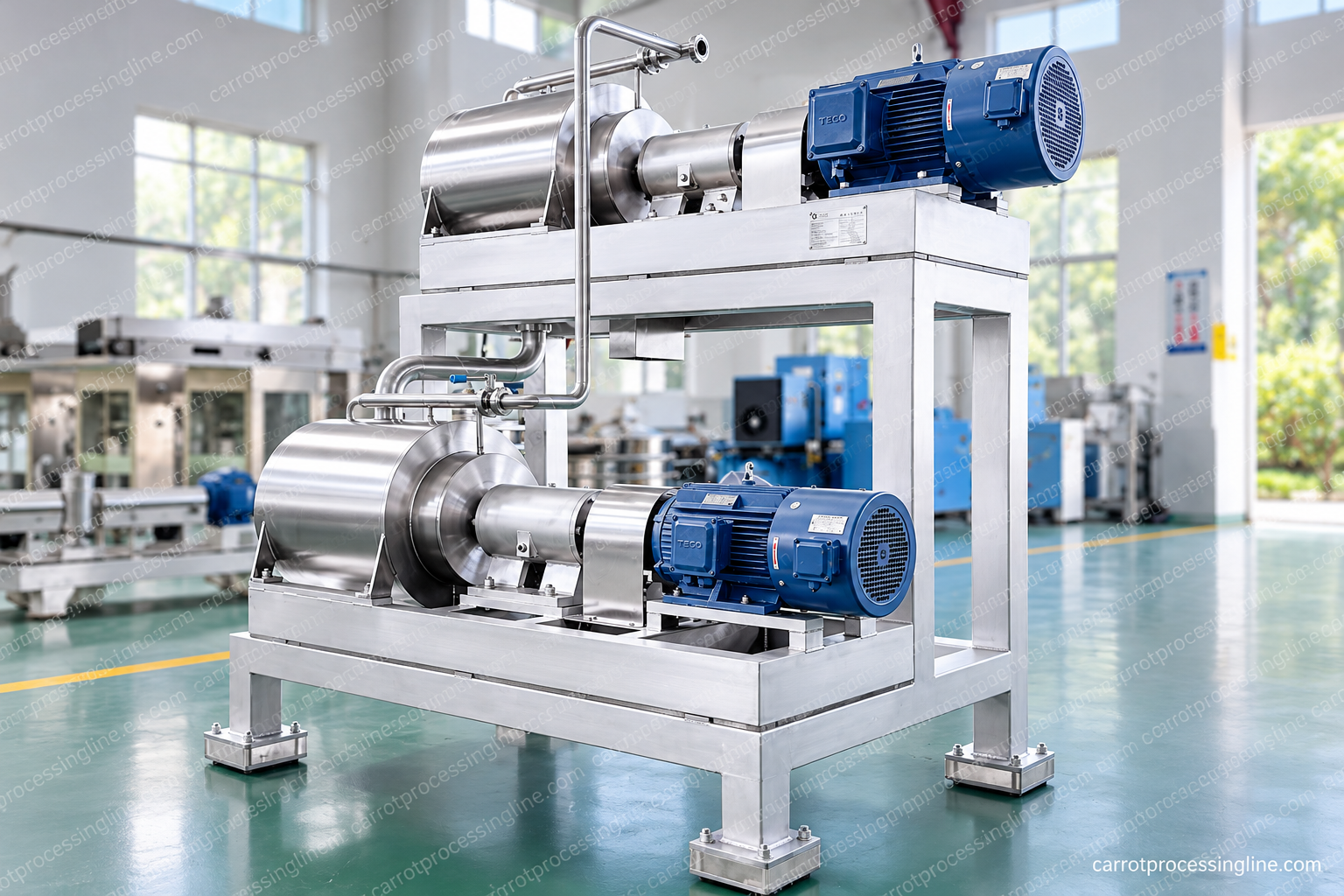
Pulping breaks down prepared roots; refining brings the product toward a defined texture. Screen selection, tissue condition and temperature all affect the result. Compare the finished sample, not only screen aperture.
Peeling and conditioning are assessed against the product brief. They are not automatic requirements. Concentration is a downstream option and does not change the extraction branch.
Photo-based presentation of two-stage pulping and refining machine. AI-refined lighting and background; selected duty requires a product trial. This is not a crop-specific delivery record.
State whether the requested kg/h refers to raw roots, prepared feed or finished product. Added ingredients, rejects, water removal and retained product must be measured separately.
Resolve the formula, process validation, package and distribution scope together. Do not substitute an acid-fruit heating schedule for a carrot product.
Clear product and equipment requirements make the next conversation useful.
What do pulping and refining contribute to carrot puree?
Pulping breaks down prepared roots, while refining helps achieve the specified texture and particle condition. Screens and operating conditions are selected using representative product trials.
Can carrot puree be concentrated?
Concentration is an additional downstream duty. Selection must account for measured solids, viscosity, particles, temperature and acceptable quality changes; a juice rating does not establish puree performance.
How do I start a puree equipment enquiry?
Share the intended product, reference texture, capacity with its measuring point, available utilities and package. The pulping, refining and transfer interfaces can then be discussed together.
 Equipment presentation