English 中文 Español Português Français العربية Skip to content Home / Carrot Pulping Machine Puree branch
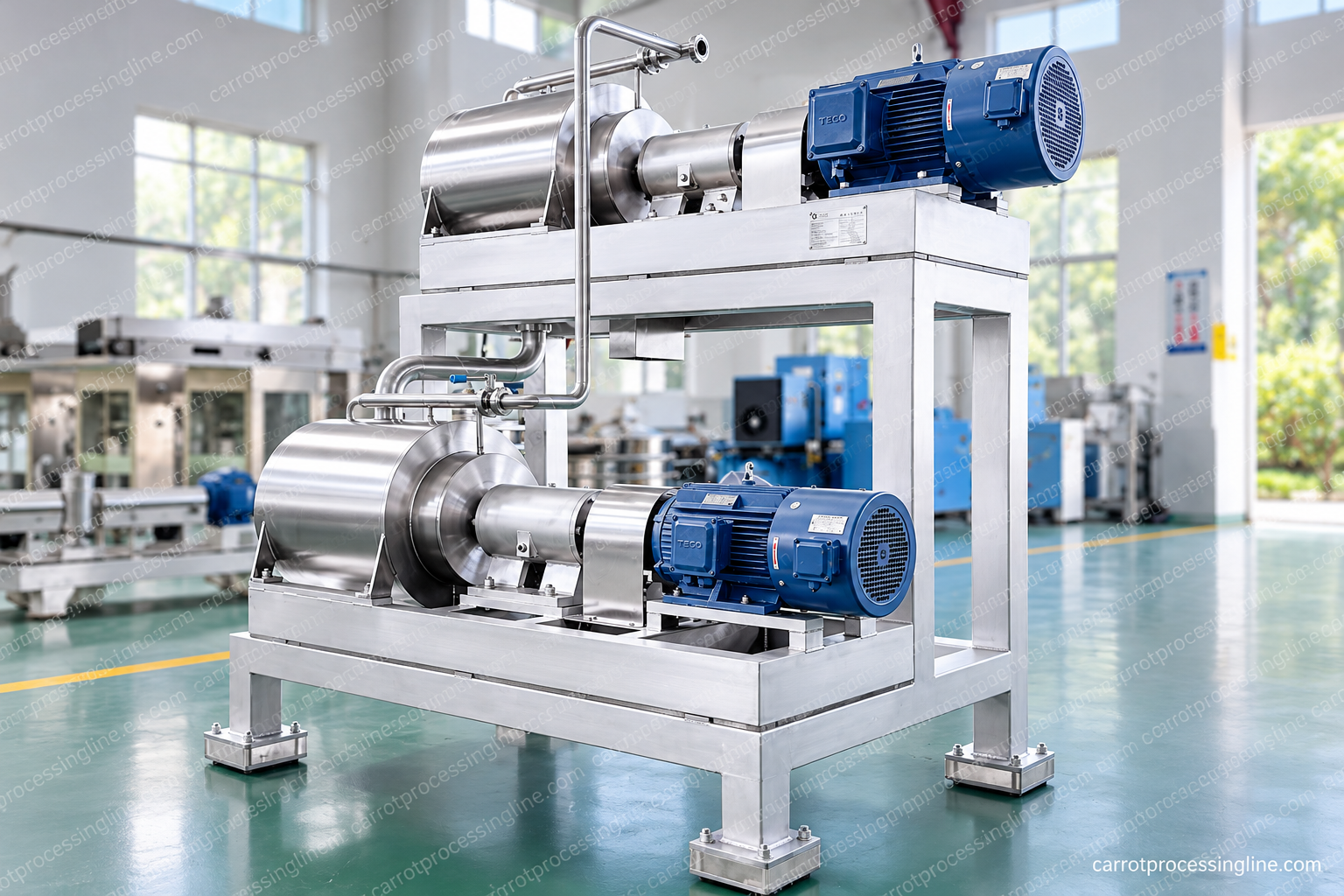
Carrot pulping machine Break down prepared roots into a pumpable pulp while separating material unsuitable for the target product.
Incoming material Cut or conditioned roots suitable for pulping Outgoing material Pulp containing comminuted tissue plus a coarse reject stream Working arrangement A feed zone, rotating working element and screen arrangement process the prepared tissue. Rotor/screen configuration must match the feed and texture requirement.
Photo-based presentation of two-stage pulping and refining machine. AI-refined lighting and background; selected duty requires a product trial. This is not a crop-specific delivery record. Specification
Define these parameters Prepared-feed dimensions and softness Screen configuration and speed basis Pulp temperature and fibre condition Reject handling and accessible wear parts Compare pulp texture, coarse rejection and downstream refining duty on the same representative feed.
Open parameter panel ↗ Integration
Connect the interfaces Match the pulper outlet to the refiner and transfer pump. Record coarse rejects separately from product output.
Cleaning and access Provide safe access for screen removal, rotor inspection, seal cleaning and removal of lodged fibres.
A pulper is not a liquid extraction press. It does not independently guarantee a smooth finished puree.
Connected equipment Equipment presentation Puree branch
Bring puree texture toward the agreed sample or measurable specification.
In Carrot pulp with a defined fibre and particle distribution Out Refined puree and a controlled coarse fraction Product buffer and transfer system Juice or puree at a measured process condition → Controlled feed to concentration, treatment or an existing process
Configuration and equipment drawing follow the confirmed process scope. Downstream interface
Keep the correct product branch moving without losing its capacity and hygiene boundaries.
In Juice or puree at a measured process condition Out Controlled feed to concentration, treatment or an existing process Project enquiry
Discuss this equipment in your line Start with the product, raw material and production basis.
Discuss your project ↗ Before you enquire
Questions worth answering. Clear product and equipment requirements make the next conversation useful.
What does the carrot pulping machine do? Break down prepared roots into a pumpable pulp while separating material unsuitable for the target product.
How should this equipment be selected? Compare pulp texture, coarse rejection and downstream refining duty on the same representative feed.
What information should I include in the enquiry? Prepared-feed dimensions and softness; Screen configuration and speed basis; Pulp temperature and fibre condition; Reject handling and accessible wear parts. Include the upstream and downstream product interfaces.
Multi-stage root washing system Raw-root input, kg/h and lot size Soil condition and root dimensions Make-up water, screening and wastewater basis Discharge height and carryover water Compare machine arrangements with representative dry soil, sticky mud, broken roots and seasonal variation.
Read the complete equipment scope →
Enquire about this equipment
Stone separation module Stone size and density distribution Root buoyancy and size range Water flow and reject removal arrangement Inspection and isolation access Request a challenge trial using representative roots and identified foreign-material hazards.
Read the complete equipment scope →
Enquire about this equipment
Root inspection conveyor Belt loading and product layer Inspection staffing or detection method Reject location and collection Conveyor speed and washdown access Define unacceptable defects and foreign material before comparing throughput.
Read the complete equipment scope →
Enquire about this equipment
Optional root peeling module Peel acceptance criterion Root shape and seasonal variation Measured peel loss and water demand Cleaning and wear-component access Compare peeled and unpeeled sample products against the actual customer specification.
Read the complete equipment scope →
Enquire about this equipment
Carrot cutting and size reduction Incoming root dimensions Required cut distribution or mash condition Product temperature and feed continuity Knife access and foreign-material protection Run extraction trials with the proposed particle size and record the resulting product and side stream.
Read the complete equipment scope →
Enquire about this equipment
Optional conditioning / softening unit Purpose of conditioning and trial evidence Residence-time distribution and product temperature Heating medium and dilution impact Drain-down and startup handling Compare the product, energy demand and extraction behaviour with and without the proposed conditioning step.
Read the complete equipment scope →
Enquire about this equipment
Carrot juice extraction press Mash particle size and temperature Liquid quality and solids target Feed rate on prepared-mash basis Residue moisture, cleaning and collection Measure juice, residue and cleaning losses using the same batch boundary before comparing offers.
Read the complete equipment scope →
Enquire about this equipment
Juice solids separation / finishing Incoming solids and particle distribution Desired cloud and sediment behaviour Feed temperature and viscosity Side-stream quantity and cleaning cycle Use retained product samples and an agreed test method for suspended solids or sedimentation.
Read the complete equipment scope →
Enquire about this equipment
Carrot pulping machine Prepared-feed dimensions and softness Screen configuration and speed basis Pulp temperature and fibre condition Reject handling and accessible wear parts Compare pulp texture, coarse rejection and downstream refining duty on the same representative feed.
Read the complete equipment scope →
Enquire about this equipment
Puree refining and texture control Retained reference sample or particle criterion Screen choice and product temperature Pressure, throughput and screen loading Reject balance and wear limits Evaluate the cooled product as well as the processing-temperature sample using the agreed method.
Read the complete equipment scope →
Enquire about this equipment
Product buffer and transfer system Product viscosity at a stated temperature and method Flow range, pressure and available inlet condition Buffer working volume and residence time Drainability, seals and cleaning return Use measured product behaviour and a pressure-drop assessment at the limiting process condition.
Read the complete equipment scope →
Enquire about this equipment
Optional concentration module Initial and target soluble/total solids with method Feed and discharge viscosity Residence time and quality limits Steam, vacuum, cooling and condensate interfaces Trial the product through the intended solids range; do not extrapolate juice evaporator performance to puree.
Read the complete equipment scope →
Enquire about this equipment
Product-specific thermal treatment Product formulation, acidity and rheology Validated process requirement and flow envelope Heating/holding/cooling instrumentation Fouling, differential pressure and utilities Resolve the process and package responsibility before promising shelf stability or ordering a heating skid.
Read the complete equipment scope →
Enquire about this equipment
Product and package filling interface Package format, fitment and fill weight Product temperature, viscosity and particles Throughput expressed as packages and product mass Cleaning, sterilization and closure requirements Confirm actual package compatibility and filling trials before specifying a model.
Read the complete equipment scope →
Enquire about this equipment
Cleaning and drain-down system Circuit inventory and manual-clean boundaries Product deposits and worst-case soil Cleaning return, drainage and utilities Verification points and safe isolation Map each equipment item to a cleaning circuit or accessible manual task and prove the end-of-run condition.
Read the complete equipment scope →
Enquire about this equipment
 Equipment presentation